Toothpaste: The Daily Dose of Blind Faith
Every morning, millions of people put a chemical formulation into their mouths without giving its ingredients a second thought. They do it because the advertising tells them to, the packaging reassures them, and generations have been conditioned to believe that a minty foam is the price of a healthy smile.
But here is the question nobody in the toothpaste business is particularly keen to encourage: are you choosing your toothpaste, or is the toothpaste industry choosing for you?
Start with the label. Not the promises on the front, but the small print on the back. That is where the marketing ends and the chemistry begins.
Glycerin appears in many formulations to keep the paste moist. Some natural-health advocates argue that it leaves a film on the teeth that interferes with saliva’s ability to remineralise enamel. The evidence for that particular claim is inconclusive, but the larger point stands: ingredients deserve scrutiny, not unquestioning acceptance.
Then consider the plastic microbeads once used in certain toothpastes, including some Crest products. In 2014, dental hygienist Trish Walraven helped draw attention to tiny blue particles lodged in patients’ gums. The concern was that trapped particles might complicate cleaning and create places for plaque to accumulate.
There was an environmental problem, too. Plastic particles washed down drains can contribute to marine pollution, and microplastics have subsequently been found in seafood.
Procter & Gamble phased out polyethylene microbeads from its Crest toothpastes by 2016. The episode illustrates an uncomfortable truth: an ingredient can pass through the machinery of commercial approval and still become the subject of legitimate public concern.
The lesson is not that every toothpaste is dangerous. It is that a product’s widespread use is not proof that every ingredient deserves your unquestioning confidence.
Follow the money, not the foam
Toothpaste is big business. Its manufacturers have every commercial incentive to sell you a product, distinguish it from competitors and persuade you that you need it every day. That does not make the product bad. It does mean that advertising should not be mistaken for independent evidence.
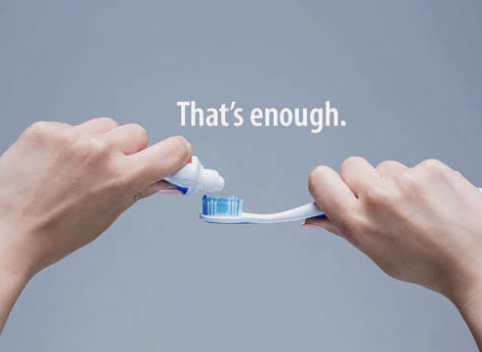
Watch the commercials. Perfect teeth. Perfect smiles. A luxurious stripe of paste spread from end to end across the brush. A little foam, a few seconds of theatrical brushing, and a grin bright enough to guide aircraft home.
The reality is less glamorous. Adults generally need no more than a pea-sized amount. The advertising spectacle is not a dental prescription; it is a sales technique.
And those coloured squares on toothpaste tubes? They are manufacturing registration marks, used by machinery to position and seal packaging. They do not tell you whether the contents are natural or synthetic. That internet myth can safely be put to bed.
The reality is that what you eat in terms of your diet is considerably more important than your toothpaste.
Fluoride presents a more serious question. It has substantial evidence supporting its effectiveness in preventing tooth decay. Excessive swallowing, particularly by young children, can be harmful, and prolonged excessive exposure while teeth are developing can cause dental fluorosis.
That is why appropriate quantities and supervision matter. It is not evidence that fluoride toothpaste, correctly used, is inherently dangerous.
Nor does the word natural confer a magical exemption from scrutiny. Natural ingredients can be harmful; synthetic ones can be perfectly safe. What matters is the ingredient, the concentration, the evidence and the way the product is used.
That is the standard every toothpaste should meet.
Your mouth. Your decision.
The real problem is not that every toothpaste is toxic. It is that most people have never been encouraged to distinguish between what a product demonstrably does and what its manufacturer would like them to believe.
We have been taught to associate foam with cleaning, mint with freshness, whiteness with health and a familiar brand with safety. These associations are commercially useful. They are not substitutes for evidence.
Read the ingredients. Investigate the claims. Understand what the active components do. If you prefer a formulation without particular additives, choose one on the basis of reliable information rather than internet folklore. And do not abandon established measures for preventing tooth decay simply because an ingredient sounds unfamiliar.
The central issue is informed choice. Not blind faith in a brand, blind faith in a regulator, or blind faith in the latest natural-health crusade.
You only get one set of adult teeth. Looking after them is sensible. Knowing what you put on them is equally sensible.
The next time you pick up a tube of toothpaste, turn it over before you put it in your basket.
The most revealing words may not be the ones printed in large letters on the front. They may be the ones the manufacturer hoped you would never bother to read.
But I get it – we’re already in crazy times and budgets are tight. So I’m inviting you to make your own toothpaste. It’s that simple, a 10-year-old child can do this. And there won’t be any questionable chemicals in what you create.
Fifteen years ago I made this short video to show people how simple if can be to make toothpaste at home.
https://www.youtube.com/watch?v=AFLRZ9d67tA


Leave a Reply
Want to join the discussion?Feel free to contribute!