Your Mouth Is More Than a Mouth
As additional material to our last article – The Mouth Is Not Separate From The Body – we highlight here the important electrical aspects of the mouth.
We tend to think of the mouth as the foyer of the body. Teeth, tongue, coffee, the occasional regrettable sandwich and, if we’re conscientious, a twice-daily encounter with a toothbrush.
But perhaps we’ve been looking at it from the wrong end.
The mouth is not an isolated dental suburb. It is a biological crossroads – wet, mineral-rich, electrically active and intimately connected to the rest of us.
Unlike Las Vegas, what happens in the mouth doesn’t necessarily stay there.
Nearly half of adults over 30 have some form of gum disease, according to widely cited estimates. There may be little pain, no warning light on the dashboard and nothing to suggest something has gone wrong until a dentist points it out.
The mouth-body connection
We’ve become accustomed to thinking of dentistry as repair: fill the hole, extract the tooth, clean the plaque, replace what’s missing and send everyone home.
But what is happening beneath the surface?
Periodontal (gum) disease involves inflammation and infection of the tissues supporting the teeth. Research has found associations between periodontal disease and systemic conditions including cardiovascular disease and diabetes.
That doesn’t mean gum disease causes every condition with which it is associated. Biology is rarely that obliging. There are shared risk factors, complex inflammatory pathways and plenty we still don’t understand.
But it is reason enough to take the mouth seriously.
And then there is mercury amalgam. It’s worth noting here that the EU banned dental amalgam fillings in January 2025. Russia once used amalgam, but in 1982 it was legally prohibited for children under the age of 18. In 1987 usage dropped altogether and by 2021 Russia could report to the World Health Organization (WHO) that dental amalgam was no longer used.
Following a major global agreement under the UN’s Minamata Convention on Mercury, over 150 countries committed to a complete global phase-out of dental amalgam by December 31, 2034. Eight more years of toxic amalgams is unacceptable.
Imagine someone standing over you and saying: “You know that thing you’ve been putting in your mouth for years? It’s highly toxic. We’ve known for a while. But don’t worry, we’re going to ban it in eight years.”
What would you do?
If only for the patients’ sake, it should have been made immediate rather than for a further eight years.
Amalgam fillings contain mercury alongside other metals. Major health authorities blithely regard dental amalgam as safe for most people when used appropriately, although concerns about mercury exposure have led to restrictions in some circumstances and have thankfully brought about a gradual move towards alternatives.
The electrical mouth
Now we get to the bit that fascinates me.
Your mouth is, in a very literal sense, a tiny electrical environment.
Saliva contains dissolved minerals and ions, which means it conducts electricity. Put different metals into that salty environment and you have the ingredients for electrochemical activity.
Dental metals can participate in galvanic reactions. Tiny electrical potentials can be measured between different metals in an oral environment. Corrosion and metal-ion release are established phenomena in dentistry.
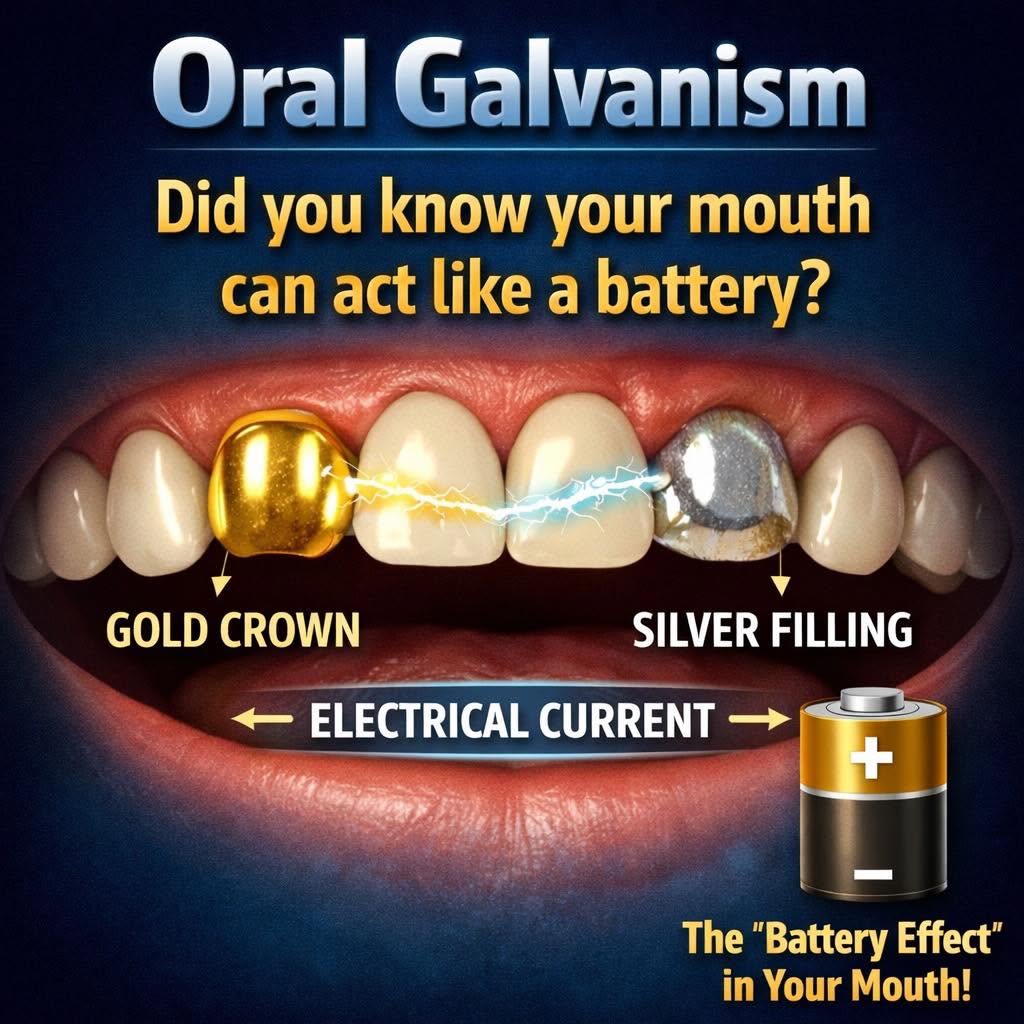
This doesn’t mean that every filling is secretly broadcasting a dangerous electromagnetic signal into your brain. That would be taking the argument somewhere the evidence doesn’t support.
But it does mean the mouth isn’t electrically inert.
Then consider chewing. Mechanical forces are converted into biological signals. Cells respond to physical forces through mechanotransduction.
The mouth is therefore a remarkable meeting point of chemistry, biology, mechanics and electrical activity.
Call it an energetic microcosm if you like.
I do.
Teeth and Voltage
Dr Jerry Tennant is an American ophthalmologist and ophthalmic plastic surgeon who, while trying to recover from encephalitis, arrived at an idea that sounds faintly eccentric until you remember that the body is, among other things, an electrical machine.
His proposition is simple enough: cells have an electrical environment, and healthy cells operate within a narrow voltage range – roughly minus 20 to minus 25 millivolts. When that voltage falls, he argues, the cellular environment becomes increasingly hospitable to disease.
And then there are the teeth.
Tennant regards a tooth rather less as an inert lump of enamel to be drilled, filled and billed, and more as a living electrical system. Dental infection, he argues, can interfere with its voltage and the pathways connected to it. Emotional stress, he suggests, may also disturb this electrical balance.
In his model, the healthy tooth has a natural fluid movement that helps defend it against decay. Disrupt that system and bacteria gain an opportunity. The apparently innocent filling can then become a larger filling, followed by a crown and, eventually, the dentist’s grand finale: the root canal.
His larger contention is that medicine has become remarkably good at chemistry while paying rather less attention to electricity, despite the fact that biology runs on both.
Tennant’s electrical theory raises is an interesting question: are we looking at the body as a collection of chemical reactions when we should also be asking what happens electrically?
Look inside the mouth
This is why I find the emerging interest in biological dentistry fascinating. Not because every claim made under its banner is automatically true, but because it encourages better questions.
Could persistent gum inflammation matter? Could an apparently healthy tooth harbour a problem beneath the surface? Is the material being put into the mouth appropriate?
Here, caution matters. If amalgam removal is appropriate, it should be planned with a suitably qualified dental professional, because careless removal can increase exposure rather than reduce it.
Don’t rip out perfectly serviceable dentistry because somebody on the internet frightened you.
Don’t ignore a persistent dental infection because it doesn’t hurt.
And don’t assume that a mouth is healthy simply because you can smile at yourself in the bathroom mirror.
The mouth is part of the body. It contains bacteria, blood vessels, nerves, immune activity, minerals, metals, mechanical forces and electrical phenomena.
Perhaps we should stop thinking of dentistry as simply fixing teeth and start thinking about oral health as whole-body health.
Because the most important thing in your mouth isn’t your smile.
It’s you.
And then there’s the jaw
There is another layer to this which conventional dentistry doesn’t always discuss in the same language: the network of nerves, blood vessels, connective tissues and signalling pathways linking the teeth, jaw, tongue and wider nervous system.
The mouth is not a collection of independent objects screwed into the skull.
It is living tissue.
And living tissue communicates.
Could that persistent gum inflammation matter?
Could an apparently healthy tooth harbour a problem beneath the surface?
Is the material being put into the mouth appropriate?
What happens when several different metals coexist in saliva for twenty or thirty years?
And, perhaps most importantly, are we treating the mouth as part of the person rather than simply repairing the hardware?
These aren’t questions that should be answered by fear.
They should be answered by evidence.


Leave a Reply
Want to join the discussion?Feel free to contribute!